

TL;DR:
- Nearly half of Asia-Pacific organizations are investing in workplace quality and employee experience, but many skilled migrants rely on superficial employer branding when making career decisions.
- Research shows the importance of evidence-based workplace insights, including regional data, to evaluate true work conditions and avoid costly mismatches.
Nearly half of Asia-Pacific organisations are investing in workplace quality and employee experience — yet most skilled migrants make career decisions based on job titles, visa eligibility, and employer branding rather than what work actually feels like day to day. That gap is costly. Professionals who relocate without assessing real workplace conditions risk landing in roles that look great on paper but deliver a very different reality on the ground. This guide brings the latest research together so you can evaluate workplaces the way experienced international professionals do: with evidence, not guesswork.
Table of Contents
- Why workplace insights matter for cross-border careers
- What the research reveals: Key trends in the Asia-Pacific workplace
- Navigating the gap: Policies, practice, and credible signals
- Applying workplace insights to your next international move
- Why measuring the real workplace matters more than ever
- Next steps: Use workplace insights for a smarter relocation
- Frequently asked questions
Key Takeaways
| Point | Details |
|---|---|
| Data-driven insight | Use evidence from reputable Asia-Pacific sources to evaluate workplace quality, not just employer branding. |
| Mind the policy-practice gap | Real working conditions may differ from stated values; check for measurable signals. |
| Technology adoption varies | AI, desk booking and workplace sensing are not yet universal—check employer practices directly. |
| Apply insights for success | Turn research into interview questions, onboarding checklists, and negotiation strategies for your move. |
Why workplace insights matter for cross-border careers
When people talk about workplace culture, they often mean something vague: a company values poster on the wall, a recruiter’s description of a “supportive team,” or a ranking on a generic “best employer” list. None of that is what we mean by workplace insights. Workplace insights are data-driven evidence of real working conditions, employee experience, and the gap between stated policy and actual practice.
This distinction is especially important for professionals starting your Asia-Pacific career from overseas. You are making decisions from a distance, often without the personal networks that give local candidates an honest inside view. Glossy employer branding is designed to attract you, not inform you. You need harder evidence.
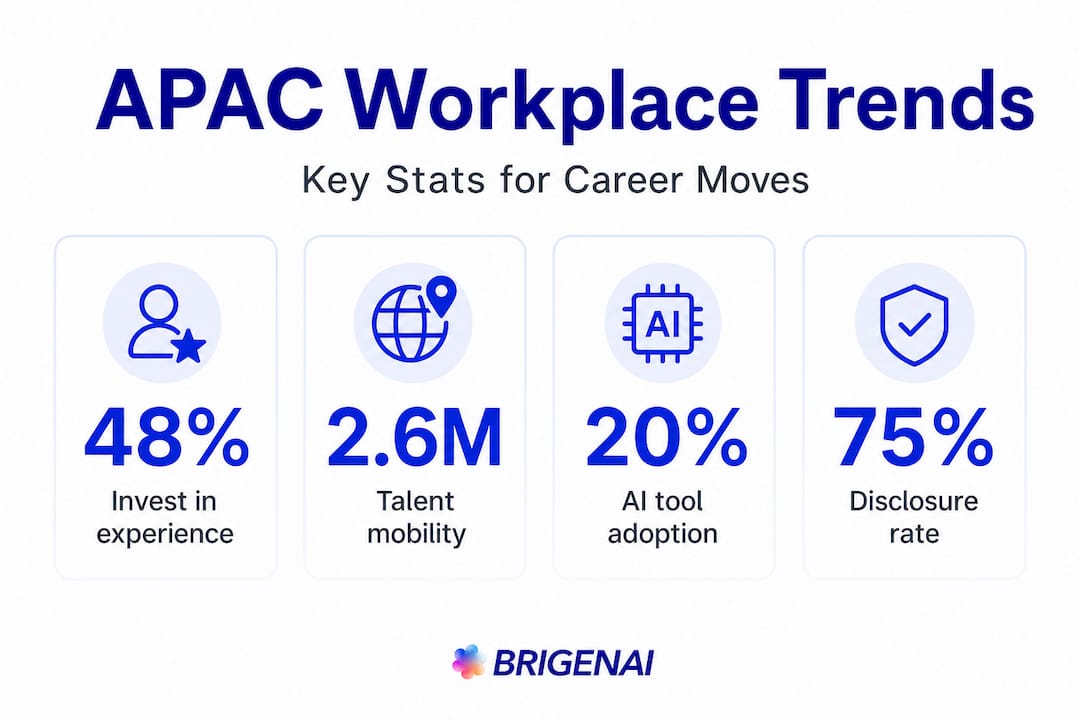
The research increasingly supports a more rigorous approach. 48% of organisations have invested or plan to invest specifically to drive workplace quality and employee experience across Asia-Pacific. That is a meaningful signal that organisations are paying attention to this space. But investment intent and measurable outcomes are two different things, and the gap between them is exactly where career decisions go wrong.
What adds genuine weight to your evaluation is regionally specific, statistically credible research. The APAC culture white paper from Octanner draws on a sample of 7,143 people across Japan, Singapore, Australia, China, Hong Kong, and the Philippines. That kind of geographic breadth and sample rigour gives you a reliable baseline for what “good” actually looks like across different markets.
For professionals exploring career growth through relocation, this matters enormously. The workplace you land in will shape your skills trajectory, your professional network, and your daily quality of life. Getting it right starts with knowing what questions to ask and where to find credible answers.
- Look for research with defined sample sizes and specific APAC country coverage
- Prioritise employer data that distinguishes intent from measurable outcomes
- Treat any data point without methodology with healthy scepticism
- Cross-reference employer claims against published industry benchmarks
Pro Tip: Build your employer shortlist using published Asia-Pacific workplace research as a benchmark, not global best-employer lists that often reflect head office conditions in the United States or Europe rather than the region you are actually moving to.
What the research reveals: Key trends in the Asia-Pacific workplace
Now that we have set out why insights matter, it is time to decode what the latest research says is really changing on the ground.
Technology adoption inside workplaces is accelerating, but unevenly. According to Colliers’ 2026 data, 20% of organisations now use AI tools to enhance employee experience, 6% use desk booking data to manage space and workload, and just 3% have occupancy sensors in place. These numbers tell you something important: most workplaces are still early in their technology transformation. An employer claiming to be “AI-driven” in their workplace experience deserves follow-up questions, because the majority have not yet implemented even basic data tools.

Talent mobility is another critical lens. BCG’s research found that 2.6 million skilled professionals relocated across borders globally in 2024, representing approximately 1.3% of the tracked global talent pool. Importantly, mobility growth slowed for the first time in recent years, which signals that competition for the best international roles is intensifying. Waiting for the “right moment” carries real cost when mobility is tightening.
| Trend | Current data point | What it means for you |
|---|---|---|
| AI workplace tools | 20% of organisations | Most employers are early adopters; probe their actual use |
| Desk booking technology | 6% of organisations | Hybrid work infrastructure is still developing |
| Occupancy sensors | 3% of organisations | Real-time data use is rare; ask how decisions are made |
| Workplace experience investment | 48% investing/planning | Strong intent; verify with measurable outcomes |
| Cross-border talent mobility | 2.6 million moves in 2024 | Competition for roles is high; move with research behind you |
When you compare career pathways for moving abroad, these data points become selection criteria rather than background reading. An employer using AI tools thoughtfully to manage workloads and employee wellbeing is meaningfully different from one that lists “technology” as a cultural value without any operational evidence.
Here are the key things these numbers reveal for your job search:
- Workplace investment is real but uneven. Nearly half of organisations are investing in experience, which is genuinely promising. The other half are not, and that gap matters for your daily work life.
- Technology signals intention. Low adoption rates mean questions about technology are differentiating, not basic. Asking about this in interviews gives you real information.
- Mobility competition is rising. Fewer professionals are moving internationally, but the ones who are moving are increasingly research-driven. Understanding what career consultants offer can give you a structural advantage.
- Culture research is region-specific. APAC culture findings differ markedly from European or North American baselines. Use regionally grounded data in your evaluation.
Navigating the gap: Policies, practice, and credible signals
With trends in hand, it is important to recognise that understanding the gap between stated intent and actual practice is vital for making reliable career decisions.
The Thomson Reuters Foundation’s Workforce Disclosure Initiative provides some of the most direct evidence of this problem. Their 2025 analysis of publicly available data from 2,972 companies, supplemented by in-depth insights from more than 140 organisations that voluntarily disclosed workforce data, found that the core challenge is translating governance structures into measurable workforce outcomes. In plain terms: companies can have excellent policies on paper and poor results in practice. Governance and impact are different things.
For skilled migrants, this is one of the most valuable insights in the entire research landscape. You will encounter employers with well-written diversity commitments, detailed flexible work policies, and elaborate onboarding frameworks. The question is not whether those policies exist. The question is whether they show up in how people actually work.
Here is how to spot the credible signals:
- Investment evidence over intent: Ask specifically what has changed in the past 12 months as a result of stated commitments, not what they plan to do.
- Measurable outcomes: Look for data on retention rates, employee survey participation, and promotion rates for international or migrant employees.
- Disclosure behaviour: Companies that voluntarily disclose workforce data publicly tend to have more accountable cultures than those that keep it internal.
- Technology with purpose: Desk booking data and occupancy sensors, however limited their current adoption, suggest an employer is using evidence to make decisions rather than relying on gut instinct.
| Signal type | Weak version | Strong version |
|---|---|---|
| Workplace commitment | “We value our people” | Specific investment figures and outcomes |
| Flexible work | Policy document exists | Data on uptake, team norms, and manager behaviour |
| Diversity and inclusion | Campaign imagery | Disclosed workforce composition and progression data |
| Technology use | Mentions AI in pitch | Specific tools in use and how they affect your role |
Understanding the international hiring process gives you the context to introduce these questions at the right stage. Early in the process, broad cultural questions make sense. As you move deeper, the specificity of your questions should increase. A hiring manager who cannot answer questions about investment outcomes or disclosed workforce data is giving you information, even if it is not the information they intend to share.
Your essential job hunt guide and the skills list for visas can anchor the practical side of your search, while workplace insight evaluation becomes your filter for separating good opportunities from genuinely great ones.
Pro Tip: Build a simple spreadsheet with your target employers listed down one side and key measurable signals across the top. Filling it in during your research phase will reveal patterns quickly and help you prioritise your time on applications that are actually worth pursuing.
Applying workplace insights to your next international move
With a practical understanding of what to look for, here is how you can turn workplace insight into a decisive advantage in your next move.
The process starts before you apply. When you shortlist employers, search for publicly available workforce disclosures, sustainability reports, and any APAC-specific employee survey results. Companies that publish this information are self-selecting as more accountable. Those that do not are not necessarily poor employers, but you will need to work harder to extract reliable signals.
Once you are in the interview process, the Workforce Disclosure Initiative’s findings provide a clear framework: ask specifically how governance structures translate into measurable outcomes for employees. Use language that invites a specific answer. “Can you tell me about the most recent change made as a result of employee experience data?” is far more diagnostic than “What is the culture like here?”
Here is a step-by-step checklist for moving from insights to practical action:
- Research phase: Gather data from Colliers, Octanner, BCG, and the Workforce Disclosure Initiative to establish your baseline expectations for APAC employers.
- Shortlisting phase: Apply the credible signals framework above. Prioritise employers who disclose, invest, and measure.
- Application phase: Tailor your application to reflect that you understand their context. Reference their actual initiatives, not generic culture claims.
- Interview phase: Ask specific, outcome-focused questions about workplace investment, technology use, and workforce data.
- Negotiation phase: Use salary benchmarks and cost-of-living comparisons from APAC-specific sources to negotiate from an informed position.
- Onboarding phase: Observe whether stated policies match day-to-day practice from your first week. Document discrepancies early.
When finding top jobs abroad, this structured approach separates professionals who stumble into poor fits from those who make consistently good decisions across multiple moves. It is not about being cynical or demanding. It is about being informed.
Choosing the right career counsellor early in this process can also accelerate your learning. A counsellor who has made the same move you are planning will have lived experience of the gap between employer promises and actual conditions in specific markets.
Pro Tip: Document the questions you develop through this insight-sourcing process and use them consistently across all your interviews. Consistent questions let you compare answers across employers directly, which is far more useful than asking different things at different stages.
Why measuring the real workplace matters more than ever
Here is the frank take that most career guides will not give you.
Skilled professionals moving internationally often spend months researching visa pathways, salary ranges, and cost of living, then spend less than an hour genuinely evaluating whether the workplace they are entering will support or undermine their career. That imbalance is a mistake, and it is one we see repeated across market after market in the Asia-Pacific region.
The uncomfortable truth is that employer branding has become extraordinarily sophisticated. Every organisation with a recruitment budget can produce compelling content about their values, their flexibility, their innovation culture. What the research consistently shows, from the Thomson Reuters Foundation’s disclosure work to the APAC culture data, is that the gap between these claims and actual employee experience is wide and persistent. It does not close itself.
We advocate treating “workplace culture as a measurable, practice-level phenomenon” in the APAC context because the alternative, taking it on faith, carries real personal and professional risk. A mismatch between your expectations and the actual workplace can set back your career development by years, especially when you are a migrant still building your professional network in a new country.
What changes when you bring a measurement mindset to your evaluation? You ask different questions. You look for different signals. You make faster, more confident decisions about which opportunities to pursue and which to decline. And critically, you build a track record of good career decisions that compounds over time.
The professionals who thrive in international careers across Asia-Pacific are not necessarily the most talented or the most experienced. They are the ones who combine genuine expertise with rigorous evaluation of the environments they choose to work in. Research is not a substitute for skill. It is the multiplier that makes your skill land somewhere it can actually grow.
Next steps: Use workplace insights for a smarter relocation
Knowing what to look for is the first step. Acting on it with the right tools and support is what turns insight into a successful international career move.
At BRIGENAI, our platform is built around exactly this kind of evidence-based approach to international career moves. Our relocation services connect you with vetted advisors who have navigated the same APAC markets you are evaluating, giving you human experience alongside structured research. Use our international relocation checklist to make sure workplace evaluation sits alongside your visa, housing, and salary planning, not as an afterthought. Our Job Match Analyzer tool helps you assess whether a specific role and employer genuinely align with your career goals and the workplace standards the research supports. Smarter moves start with better information.
Frequently asked questions
What are the most reliable sources of workplace insights for relocating to Asia-Pacific?
The most reliable sources are large-scale workplace surveys, employer disclosure reports, and benchmarks from APAC-focused research like the Colliers 2026 report and Octanner’s APAC culture white paper, which draw on thousands of respondents across multiple countries in the region.
How can I tell if a company’s stated values match actual employee experience?
Check for data on actual investment, technology usage, and voluntary workforce disclosures, then ask targeted outcome-focused questions during interviews. The Workforce Disclosure Initiative shows that governance without measurable outcomes is a common problem across thousands of companies globally.
How do leading organisations in Asia-Pacific invest in employee experience?
48% of organisations report investing or planning to invest in workplace quality and employee experience, with a growing minority adopting AI tools, desk booking systems, and other digital workplace technologies to make data-informed decisions.
What practical questions should I ask a prospective employer about their workplace?
Ask what specific changes they have made in the past year based on employee experience data, how they use workplace technology, and whether they publish any workforce disclosure information publicly. These questions move the conversation beyond policy to actual practice.
How many skilled professionals move across borders in Asia-Pacific each year?
In 2024, around 2.6 million skilled professionals relocated across borders globally, including across the Asia-Pacific region, with BCG noting this represented approximately 1.3% of the tracked global talent pool and marked the first slowdown in recent mobility growth.