

TL;DR:
- Visa systems across Asia-Pacific are tightening, emphasizing local skills, salary benchmarks, and shortages.
- Entry pathways like working holiday visas and graduate schemes provide strategic stepping stones for young professionals.
- Success depends on integrating into local culture, building networks, and planning family needs early.
Visa rules across the Asia-Pacific region are tightening faster than most professionals expect. Singapore has overhauled its Employment Pass framework, New Zealand has introduced new graduate pathways, and Malaysia has centralised its expatriate application system entirely. Yet for skilled professionals and graduates who understand the landscape, the opportunities are genuinely exciting. This article cuts through the noise, compares real visa options across Australia, New Zealand, Singapore, Taiwan, Hong Kong, and Malaysia, and gives you a clear picture of where the doors are open and exactly how to walk through them.
Table of Contents
- Understanding visa pathways for Asia-Pacific professionals
- Graduate and working holiday schemes: Opening doors for younger talent
- Navigating skill shortages, local preference, and points systems
- Common pitfalls and family planning considerations
- Why success abroad depends on more than just visa eligibility
- Take your next step with professional relocation support
- Frequently asked questions
Key Takeaways
| Point | Details |
|---|---|
| Visa rules are tightening | Recent changes prioritise high-skill and shortage occupations, making strategic planning essential. |
| Graduate and holiday schemes offer entry | Younger talent can use flexible visa options but must watch eligibility ages and employer limits. |
| Skill lists give applicants an edge | Targeting shortage occupations increases chances for successful relocation and long-term residence. |
| Family planning matters | Dual-career and language considerations are vital—overlooking them increases risk of return migration. |
| Professional advice streamlines your pathway | Leveraging expert support and tools helps avoid the most common pitfalls and speeds up your international career move. |
Understanding visa pathways for Asia-Pacific professionals
Every destination in the Asia-Pacific region has its own logic when it comes to skilled migration. The challenge is that these systems change frequently, and what worked two years ago may no longer apply. Let’s clarify which visa pathways serve skilled professionals and graduates in each major Asia-Pacific destination.
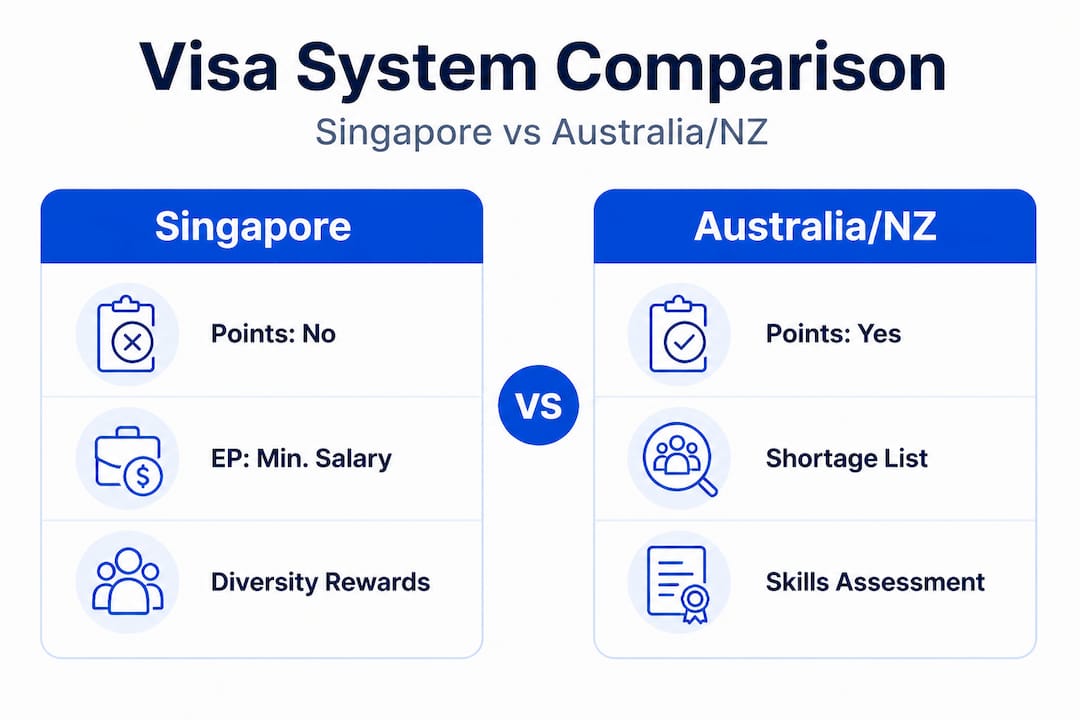
Singapore operates one of the most structured systems in the region. The Employment Pass (EP) now requires a minimum qualifying salary of S$5,600 per month for most sectors, rising to S$6,200 for financial services roles. Beyond salary, applicants must pass the COMPASS framework, a points-based assessment that evaluates four factors: salary relative to local benchmarks, qualifications, firm diversity, and support for local employment. You need at least 40 points to qualify. High earners above S$22,500 per month are exempt from COMPASS entirely, which creates a two-tier system worth understanding before you apply.
Malaysia has made a significant structural change. The MIDA Expatriate System, launched in March 2026, centralises Employment Pass and Professional Visit Pass applications for the manufacturing and services sectors through a single digital platform. This replaces a fragmented process that previously required applicants to navigate multiple agencies. For professionals targeting Malaysia, this is genuinely good news as it reduces processing time and improves transparency.
Australia and New Zealand both operate points-based skilled migration systems tied to occupation shortage lists. Australia uses the Skilled Occupation List and the Short-Term Skilled Occupation List (STSOL), while New Zealand’s Green List identifies roles eligible for fast-tracked residency. For a thorough overview of the New Zealand system, the New Zealand emigration guide on BRIGENAI covers the full pathway from application to arrival.

Here is a quick comparison of the main visa categories across the region:
| Destination | Main visa type | Key requirement | Points system? |
|---|---|---|---|
| Singapore | Employment Pass | S$5,600+ salary, COMPASS 40pts | Yes (COMPASS) |
| Malaysia | Employment Pass (MES) | Employer sponsorship, digital platform | No |
| Australia | Skilled Independent (189) | Points test, occupation list | Yes |
| New Zealand | Skilled Migrant Category | Points test, job offer | Yes |
| Hong Kong | Quality Migrant Admission Scheme | Points or achievement-based | Yes |
| Taiwan | Employment Gold Card | Salary or professional achievement | Partial |
The key takeaway from this comparison is that no two systems are identical. Singapore rewards salary and diversity metrics. Australia and New Zealand weight occupation demand heavily. Hong Kong and Taiwan offer more flexible achievement-based tracks for high-performing professionals. Knowing which system aligns with your profile is the first real decision you need to make.
Graduate and working holiday schemes: Opening doors for younger talent
After reviewing main professional visas, let’s see what options exist for students and younger professionals. These pathways are often underutilised, yet they can be genuinely strategic entry points into competitive job markets.
New Zealand has introduced meaningful updates for recent graduates. The Short-Term Graduate Work Visa grants up to six months of open work rights for graduates who completed a level 5 to 7 qualification through at least 24 weeks of full-time study in New Zealand. This gives you time to find an employer willing to sponsor a longer-term work visa, which is far easier once you have a local credential and some New Zealand work experience on your CV. New skilled migrant pathways introduced in 2026 have also expanded the range of qualifications that qualify, making this route accessible to a broader group of graduates.
For younger professionals who want to test a country before committing to a full skilled migration pathway, working holiday visas are often the smartest first move. Bilateral working holiday agreements between Hong Kong, Taiwan, Australia, and New Zealand allow applicants aged 18 to 30 (or 35 in some cases) to live and work for up to 12 months. Financial proof requirements vary: roughly HK$20,000 for Hong Kong agreements, NT$100,000 for Taiwan, and NZD$5,000 for New Zealand. Each scheme typically limits employment with a single employer to three to six months, which is designed to encourage travel rather than full-time career building.
That said, many professionals use working holiday time strategically. They identify target employers, build local networks, and position themselves for sponsorship before their holiday visa expires.
Pro Tip: If you are on a working holiday visa, use the employer time limit to your advantage rather than fighting it. Work three months with a company in your field, then approach a second employer in a related role. By the end of your visa, you will have two local references, broader industry contacts, and a much stronger case for a skilled work visa application.
For a detailed breakdown of New Zealand’s work visa options, the NZ work visa guide on BRIGENAI is worth bookmarking. And if you are planning a full relocation, the NZ relocation step-by-step guide covers everything from housing to banking to healthcare registration.
| Scheme | Age limit | Financial proof | Employer limit |
|---|---|---|---|
| HK Working Holiday | 18 to 30 | HK$20,000 | 3 to 6 months |
| Taiwan Working Holiday | 18 to 30 | NT$100,000 | 3 to 6 months |
| NZ Working Holiday | 18 to 35 | NZD$5,000 | 3 months (some roles) |
| Australia Working Holiday | 18 to 30/35 | AUD$5,000 | Varies by visa subclass |
Navigating skill shortages, local preference, and points systems
With entry pathways covered, it’s crucial to understand how skill shortages and points-based assessment shape who succeeds. Getting a visa is one thing. Getting a visa for a role that actually leads to permanent residency is another.
Across the region, 2026 trends show that governments are tightening visa approvals to prioritise local workers, high-skill roles, and occupations with genuine shortages. Singapore’s COMPASS framework, which now applies to EP renewals from July 2026, is a clear example. Employers must demonstrate that hiring an overseas professional does not disadvantage local candidates. This means your application is not just about your credentials. It is also about whether your employer can justify the hire.
Here is how to build a genuinely competitive profile across the region:
-
Target shortage occupations first. In New Zealand, the Green List identifies roles eligible for straight-to-residence pathways, including engineers, nurses, and ICT professionals. In Australia, the STSOL shortage list is updated regularly and determines which occupations qualify for sponsored work visas.
-
Quantify your experience clearly. Points systems reward documented experience. Vague claims about “team leadership” or “project management” are far less effective than specific metrics such as team size, budget managed, or outcomes delivered.
-
Understand local salary benchmarks. Singapore’s COMPASS system scores your salary against the median for your occupation and nationality. If your offered salary is below the benchmark for your peer group, you lose points. Research salary data for your specific role before negotiating with employers.
-
Build local credentials where possible. A New Zealand or Australian qualification, even a short professional development course, signals commitment and reduces employer risk. This is especially relevant for NZ Green List careers where registration with a local professional body is often mandatory.
-
Consider high-salary exemption thresholds. In Singapore, professionals earning above S$22,500 per month bypass COMPASS entirely. While this is not relevant for most applicants, it illustrates the logic of the system: governments want to attract top-tier talent unconditionally, while applying more scrutiny to mid-level hires.
“The most successful international career moves we see are not the ones with the highest points scores. They are the ones where the professional understood the local labour market before applying, not after.”
Local preference is real and growing. But it does not close the door for skilled migrants. It raises the bar. The professionals who succeed are those who treat visa eligibility as the starting point, not the finish line.
Common pitfalls and family planning considerations
With competitive challenges outlined, it’s vital to prepare for family needs and common pitfalls in international relocation. Many professionals focus entirely on their own visa situation and underestimate how much family complexity can affect long-term outcomes.
The most commonly overlooked risks include:
-
Lower-skill roles with limited progression. Taking any job just to get a visa often leads to being stuck in a role that does not support permanent residency pathways. Visa conditions tied to employer sponsorship can limit your ability to change jobs, which traps you in situations that are difficult to exit.
-
Language barriers in professional settings. This is particularly significant in Singapore and Malaysia, where professional culture varies significantly by sector. Research on nurse migration found that 59% of Chinese nurses who migrated to Singapore eventually returned home, with language barriers and workplace integration cited as key factors. This pattern appears across other professions too.
-
Dual-career migration. When both partners need to work, visa conditions become far more complex. Dependent visas in Singapore and Hong Kong do not automatically grant work rights. One partner may need to apply for a separate work permit, which requires its own employer sponsorship.
-
Underestimating settlement costs. The financial strain of the first six months abroad is consistently higher than people expect. Bond deposits, school fees, health insurance gaps, and the cost of building a new social network all add up quickly.
“Return migration is not a failure. But it is almost always preventable with better planning. The professionals who stay are the ones who planned for the hard months, not just the exciting ones.”
For practical guidance on work culture and lifestyle across different Asia-Pacific destinations, BRIGENAI’s destination comparison tools give you a realistic picture of what daily professional life actually looks like. And if you are planning your job search in New Zealand specifically, the NZ job planning guide covers timelines, networking strategies, and employer expectations in detail.
Family planning is not a soft consideration. It is a core part of your migration strategy. Professionals who address it early, including schooling options, healthcare access, and partner employment rights, are significantly more likely to build lasting international careers.
Why success abroad depends on more than just visa eligibility
Here is the uncomfortable truth that most migration guides will not tell you: visa eligibility is the easiest part of an international career move. The harder work begins the day you land.
We see this pattern repeatedly. A highly qualified professional clears every visa hurdle, arrives in their destination country, and then struggles because they underestimated how different the professional culture would be. They expected their credentials to speak for themselves. Instead, they found that local networks, communication styles, and unspoken workplace norms determined who got promoted and who stayed stuck.
The professionals who build genuinely lasting international careers share a few traits that have nothing to do with points scores. They invest in local relationships early, not just professional ones. They join industry associations, attend local events, and make themselves visible in the community. They treat their first year as a learning period rather than a proving ground. And critically, they involve their families in the planning process from the start, not as an afterthought.
Points systems and visa frameworks are tools. They get you through the door. But destination culture and employee experience shape whether you stay, grow, and eventually call that country home. The professionals who thrive are those who prepare for both dimensions: the regulatory and the human.
Adaptability is not a soft skill. In an international career context, it is your most important professional asset. The visa landscape will keep changing. Salary thresholds will move. Occupation lists will be updated. The professionals who build resilient international careers are those who keep learning, keep building local credibility, and never treat their visa as the end of the journey.
Take your next step with professional relocation support
Navigating Asia-Pacific visa pathways, shortage occupation lists, and family relocation logistics is genuinely complex. But you do not have to piece it together from scattered forums and outdated government websites.

BRIGENAI brings together AI-structured guidance and real human expertise from professionals who have made the same moves you are planning. Whether you need to compare destinations, identify your eligible visa pathway, or connect with an advisor who has actually worked in your target country, the platform is built for exactly this. Explore relocation services tailored to Asia-Pacific professionals, connect with overseas career advisors who understand the local job market, or use the skills list tools to check which shortage occupations align with your background. Your next move deserves better than guesswork.
Frequently asked questions
What is the minimum salary requirement for Singapore Employment Pass in 2026?
The updated minimum qualifying salary for Singapore Employment Pass in 2026 is S$5,600 per month, or S$6,200 for financial sector roles. High earners above S$22,500 are exempt from the COMPASS points assessment entirely.
How do working holiday visa schemes differ between Hong Kong, Taiwan, New Zealand, and Australia?
Working holiday schemes in these countries are bilateral agreements open to applicants aged 18 to 30 or 35, requiring financial proof such as HK$20,000, NT$100,000, or NZD$5,000, and typically limiting employment with any single employer to three to six months.
What is Malaysia’s new expatriate application system for 2026?
Malaysia’s MIDA Expatriate System centralises Employment Pass and Professional Visit Pass applications for manufacturing and services sectors through a single digital platform, launched in March 2026. It replaces a previously fragmented multi-agency process.
Why do many migrants return home after working overseas?
Return migration rates are significantly higher for professionals in lower-skill roles or those facing language barriers in the workplace, as seen with 59% of Chinese nurses who left Singapore returning home. Early integration planning and realistic expectations reduce this risk considerably.
What occupations are most in demand for skilled visa pathways in Australia and New Zealand?
Shortage occupation lists such as New Zealand’s Green List and Australia’s STSOL identify the roles best suited for skilled visa applications, including engineering, healthcare, and ICT positions. Targeting these roles significantly improves both visa approval chances and pathways to permanent residency.