

TL;DR:
- Moving abroad offers Asia-Pacific professionals faster earnings growth, diverse skills development, and global network expansion.
- Despite challenges like integration and visa uncertainties, strategic preparation significantly mitigates risks and enhances success.
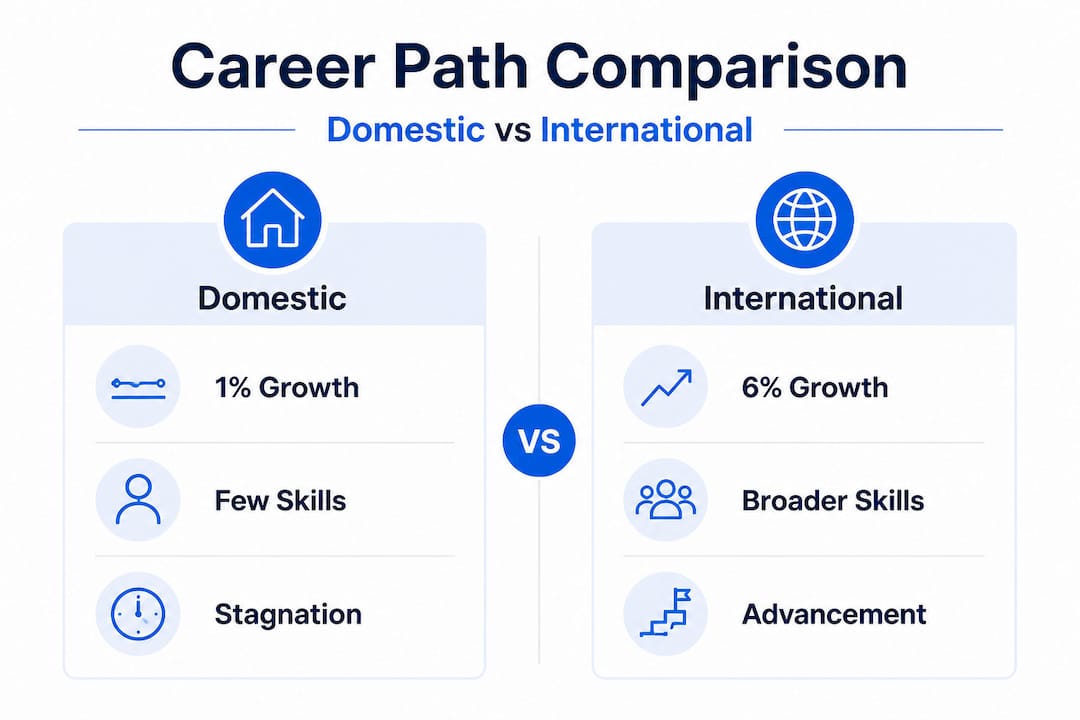
Staying put can feel like the sensible option, especially when you have a steady role and a familiar city. But the data tells a very different story. Japanese self-initiated expatriates achieve around 6% annual earnings growth compared to just 1% for domestic workers, a gap that compounds into a completely different financial reality over a decade. For professionals and graduates across the Asia-Pacific region, that single statistic is worth sitting with. This article breaks down the real case for moving abroad, the honest risks involved, and the practical steps that separate a successful international career move from a costly mistake.
Table of Contents
- Career advantages of moving abroad
- Risks and challenges: what to expect
- Practical steps for relocating abroad
- Long-term impact: personal and professional growth
- Why most career advice misses the mark on moving abroad
- Explore tools and resources for your international career move
- Frequently asked questions
Key Takeaways
| Point | Details |
|---|---|
| Earnings accelerate abroad | Self-initiated expatriates often see much higher annual pay growth than domestic workers. |
| Skill development and networks | International experience provides critical skills, global connections, and unique career pathways. |
| Risks are manageable | Return penalties and integration challenges are largely tied to individual preparation, not the act of relocating. |
| Step-by-step planning | Successful moves require research, skill validation, visa guidance, and strong local foundations. |
| Long-term benefits | Global mobility offers personal growth, resilience, and lasting career advantages across markets. |
Career advantages of moving abroad
The earnings gap between self-initiated expatriates (SIEs) and their domestic counterparts is not a fluke. It reflects something structural: when you relocate internationally, you are forced to develop faster, pitch yourself harder, and build networks you simply would not encounter by staying local. These pressures produce real, measurable career outcomes.
Research confirms that Japanese SIEs earn roughly 6x more annual wage growth than domestic workers, approximately 6% versus 1% respectively. Multiply that over ten years and the income divergence becomes enormous. But the financial upside is only part of the story.
Working abroad accelerates skills acquisition in ways that are difficult to replicate domestically. You learn how to operate in different regulatory environments, manage cross-cultural teams, communicate across language barriers, and adapt your professional style to new workplace norms. These are not soft skills in the abstract sense. They are highly sought competencies that open doors to senior roles, board positions, and consulting contracts that stay firmly closed to candidates without global exposure.
Use a global pay comparison to benchmark your current salary against equivalent roles in Singapore, Australia, New Zealand, or Hong Kong. The salary differentials can be striking, particularly for professionals in engineering, technology, finance, and healthcare.
Key career benefits of working abroad include:
- Faster wage growth, often 4 to 6 times higher than domestic peers
- Access to international professional networks that generate long-term referrals and job leads
- Exposure to workplace cultures and management styles that sharpen leadership capability
- Enhanced credibility on your CV, particularly with multinational employers
- Greater negotiating leverage when you return or transition to new roles
Pro Tip: Professionals who document their international achievements in specific, quantifiable terms, such as “managed a cross-border team of 12 across three time zones” rather than “worked internationally,” consistently report stronger interview outcomes.
| Career factor | Domestic worker | International expatriate |
|---|---|---|
| Annual earnings growth | ~1% | ~6% |
| Professional network reach | Local/regional | Global |
| Skill diversity | Industry-specific | Cross-cultural + industry |
| Senior role accessibility | Competitive | Expanded via global exposure |
| CV differentiation | Standard | High, particularly with multinationals |
Understanding global career success for graduates and professionals requires looking beyond salary. The career acceleration that comes from international experience compounds over time in ways that are hard to predict but consistently positive for those who plan their move well. It is also worth taking time to compare career pathways across different destination countries before committing to a single direction.
Risks and challenges: what to expect
While the upsides are clear, it is important to be realistic about the challenges and risks involved. Moving abroad is not a guaranteed fast track to career success. There are real obstacles, and ignoring them is the quickest way to turn a promising move into a regrettable one.
The most cited concern for returnees is the so-called “return penalty,” the idea that coming back home after working abroad can leave you worse off than peers who stayed. But the research is more nuanced than popular opinion suggests. The return penalty is largely explained by pre-migration factors, meaning it tends to affect people who already faced career disadvantages before they left, not those who moved with strong foundations and clear intent.
“The most dangerous assumption about moving abroad is not that it will be hard. It is that difficulty itself is evidence you made the wrong choice. The data says otherwise.”
Integration challenges are real and should not be minimised. Language barriers, unfamiliar workplace hierarchies, and the psychological weight of being far from your support network all take a toll. In some destination countries, particularly in parts of East Asia, social integration outside of professional settings can be slow.
Common risks and how to manage them:
- Skill gaps: Research the specific technical and soft skills valued in your target country before you move. Reviewing integration risks and skill requirements in your destination market helps you prepare rather than improvise.
- Isolation: Build social connections before you arrive. Online expat communities, industry associations, and language exchange groups are practical starting points.
- Regulatory and licensing differences: Many professions, including healthcare, law, and engineering, require requalification or additional certifications in the destination country. Factor this into your timeline.
- Visa uncertainty: Work visas are subject to policy change. Have a contingency plan and understand the full scope of your rights before signing a contract.
- Return planning: Maintain connections in your home market even while abroad. Actively nurturing your home network reduces the risk of re-entry difficulties.
| Risk factor | Domestic career | International career |
|---|---|---|
| Earnings stagnation | High | Low (with good preparation) |
| Skill obsolescence | Moderate | Low (broader exposure) |
| Integration difficulty | Minimal | Moderate to high initially |
| Return penalty risk | Not applicable | Low if pre-migration factors are strong |
| Visa instability | None | Moderate, varies by country |
For professionals considering return penalties explained in detail, the key takeaway is that preparation before the move matters far more than the move itself. If you are exploring industries with high international demand, sectors like engineering jobs abroad tend to offer clearer visa pathways and stronger salary uplifts than many other fields.
Practical steps for relocating abroad
Understanding the risks is only half the equation. Here is how to make your move a success, step by step, with a specific focus on what works for Asia-Pacific professionals.
Research published on APAC internal mobility shows that while internal moves within an organisation boost retention rates by 66 to 72 percent, professionals who want genuine career breakthroughs often need to make external international moves. Internal promotions keep you comfortable. External international moves reposition you entirely.
Before you move:
- Audit your skills against the requirements of your target market. Use tools like the skills for relocation checker to identify gaps early.
- Research cost of living, average salaries, and industry demand in your destination city, not just your destination country. Sydney and regional New South Wales are very different propositions, for example.
- Confirm your qualifications are recognised in your destination country. Professional bodies vary widely in their mutual recognition arrangements.
During your job search:
- Target roles with explicit visa sponsorship pathways, not roles that “might” consider sponsorship.
- Tailor your CV to local conventions. Australian CVs differ from Singaporean or Japanese formats in meaningful ways.
- Network before you apply. A warm introduction dramatically improves your conversion rate from application to interview.
- Use a curated resource like find jobs abroad to identify opportunities that actively support international relocation.
Once your offer is confirmed:
- Understand your visa conditions in detail before you sign. Some work visas tie you to a single employer, which limits your negotiating position.
- Arrange housing and banking before you arrive where possible. The first weeks abroad are logistically demanding enough without improvising basics.
- Connect with international career advisors who have firsthand experience in your destination country. Generic advice is rarely useful at this stage.
Pro Tip: Professionals who secure at least one professional contact in their destination city before arriving report significantly lower rates of early departure due to isolation or unexpected culture shock. This one step is consistently undervalued.
The goal is not to eliminate uncertainty. It is to reduce it to a manageable level so that the challenges you face are growth challenges, not survival ones.
Long-term impact: personal and professional growth
After practical steps, it is vital to consider the long-term rewards of moving abroad, because the compounding effects of international experience extend well beyond your first overseas role.

Expatriates achieve greater earnings and skill development through international moves, but the research is clear that reintegration support matters enormously for sustaining those gains over time. Professionals who return home without a structured reintegration plan often fail to capitalise on the very advantages they built abroad.
Long-term benefits of overseas work experience:
- Resilience: Navigating an entirely new work environment builds a capacity for ambiguity that domestic careers rarely demand at the same intensity.
- Global networks: The contacts you build abroad often become your most valuable career asset over a ten to twenty year horizon. Referrals cross borders when your network does.
- Leadership credibility: Senior hiring managers consistently rate international experience as a strong signal of initiative, adaptability, and strategic thinking.
- Personal adaptability: Living abroad changes how you problem-solve, communicate, and manage stress. These shifts are not temporary. They are permanent.
- Income trajectory: The earnings gap between internationally experienced professionals and their domestic peers typically widens over time, not narrows.
Exploring top platforms for working abroad in 2026 gives you a clear sense of where the most active job markets are and which platforms provide the most transparent visa and salary information. Reviewing detailed career pathways abroad helps you choose the right destination and industry combination for your specific background and goals.
The professionals who gain the most from international moves are not necessarily the ones with the strongest CVs before they leave. They are the ones who approach the experience with clear intentions, seek professional support abroad when they need it, and commit to building rather than simply observing in their new environment.
Why most career advice misses the mark on moving abroad
The long-term impact is clear, but the advice landscape around international careers is still dominated by two unhelpful extremes: breathless enthusiasm that ignores real risks, and risk-averse caution that ignores compelling evidence.
The reality is far more specific than either camp acknowledges. The return penalty is largely driven by pre-migration factors, not by relocation itself. This is a crucial distinction. It means that if you move abroad from a position of professional strength, with clear goals, relevant skills, and a network to return to, the feared downside largely disappears. The people most at risk are those who move to escape something rather than build something.
Conventional career advice also consistently undervalues global experience in Asian labour markets. There is still a strong cultural narrative in parts of Japan, South Korea, and mainland China that domestic career loyalty is the surest path to seniority. That narrative is increasingly disconnected from how multinational employers actually hire and promote. The organisations paying the best salaries in the Asia-Pacific region in 2026 are disproportionately those with global operations, and they actively favour candidates with international exposure.
What typical guides also overlook is the importance of tailoring your approach to the specific destination. The Asia-Pacific region is not a monolith. Career mobility strategies that work in Australia require significant adjustment for Singapore or Taiwan. Regulatory environments, workplace cultures, and visa frameworks differ enough that generic advice can actively mislead you. Connecting with career advisor expertise grounded in specific destination knowledge is not a luxury at this level. It is a practical necessity that changes outcomes.
The most honest thing we can say is this: moving abroad is not the right move for every professional at every stage of their career. But for those who are ready, the evidence consistently shows it is one of the highest-leverage career decisions available.
Explore tools and resources for your international career move
If this article has shifted your thinking, the logical next step is to move from reflection to action with the right tools behind you.

BRIGENAI is built specifically for professionals and graduates in the Asia-Pacific region who are serious about international career moves. You can review the skills list to benchmark your readiness against destination market requirements, or compare global living costs across Australia, Singapore, New Zealand, and other key destinations to understand the full financial picture. When you are ready to take practical steps, the relocation services hub connects you with vetted advisors across career counselling, immigration, housing, and healthcare. Every resource is grounded in real experience from professionals who have made exactly the move you are considering.
Frequently asked questions
Is it worth moving abroad for work if I have a stable job locally?
International experience can lead to accelerated pay growth and expanded job options, even if you are already well established. Research shows Japanese SIEs grow earnings at roughly 6% annually versus just 1% for domestic workers, a gap that compounds significantly over a career.
What are the main risks when working abroad?
Key risks include integration challenges, skill gaps, and visa instability, but research indicates the return penalty is largely explained by pre-migration factors rather than the act of relocating itself, meaning strong preparation significantly reduces your exposure.
How can Asia-Pacific professionals best prepare for relocating abroad?
Start by auditing your skills against destination market requirements, work with advisors who have firsthand knowledge of your target country, and build professional contacts before you arrive. Research confirms that APAC internal mobility supports retention but that external international moves are where real career breakthroughs tend to occur.
Will working abroad hurt my career when I return home?
The evidence consistently shows that no inherent return penalty exists once individual pre-migration factors are accounted for. Skills, networks, and international credibility built abroad generally provide a strong advantage upon return, provided you maintain connections in your home market while you are away.