

TL;DR:
- AI careers are now widely distributed globally, with talent concentrations in Israel, Singapore, and Luxembourg surpassing the US on a per-capita basis.
- Success in international AI roles depends more on employer support, workplace culture, and regulatory environments than on geographic location or job title.
Somewhere between Silicon Valley mythology and the assumption that serious AI roles only exist in a handful of global cities, a much more interesting reality has taken shape. An AI career is no longer a geography problem. AI talent has grown 130% since 2016, with the highest concentrations not in the US, but in Israel, Singapore, and Luxembourg. If you are weighing an international move and wondering whether your skills in artificial intelligence will travel with you, the short answer is yes. The more useful answer involves salary expectations, workplace culture, and how to adapt without losing momentum.
Table of Contents
- Understanding the global landscape of ai careers
- Salary expectations and role profiles in international ai careers
- Work culture and management practices shaping ai adoption abroad
- Skills and lifelong learning strategies for international ai professionals
- Practical strategies for adapting to international ai career environments
- Why focusing on employer ai enablement beats job title for career success
- Start your international ai career journey with expert tools and resources
- Frequently asked questions
Key Takeaways
| Point | Details |
|---|---|
| Global AI growth | AI talent is rapidly increasing worldwide, spreading beyond traditional tech hubs like the US. |
| Salary ranges vary | AI career salaries are high but differ widely by region and role seniority. |
| Work culture matters | Management and firm culture influence how AI is used and adopted on the job. |
| Skills mix is key | Combining AI expertise with foundational and socio-emotional skills improves career prospects. |
| Adaptation strategies | Successfully relocating requires assessing employer AI support and tailoring your skills portfolio. |
Understanding the global landscape of ai careers
The data on AI career distribution should change how you think about where to look. 7 in every 1,000 LinkedIn members globally now carry AI engineering credentials, and the countries leading that concentration are not the obvious ones. Israel sits at 1.98%, Singapore at 1.64%, and Luxembourg at 1.45%, all outpacing the US on a per-capita basis.
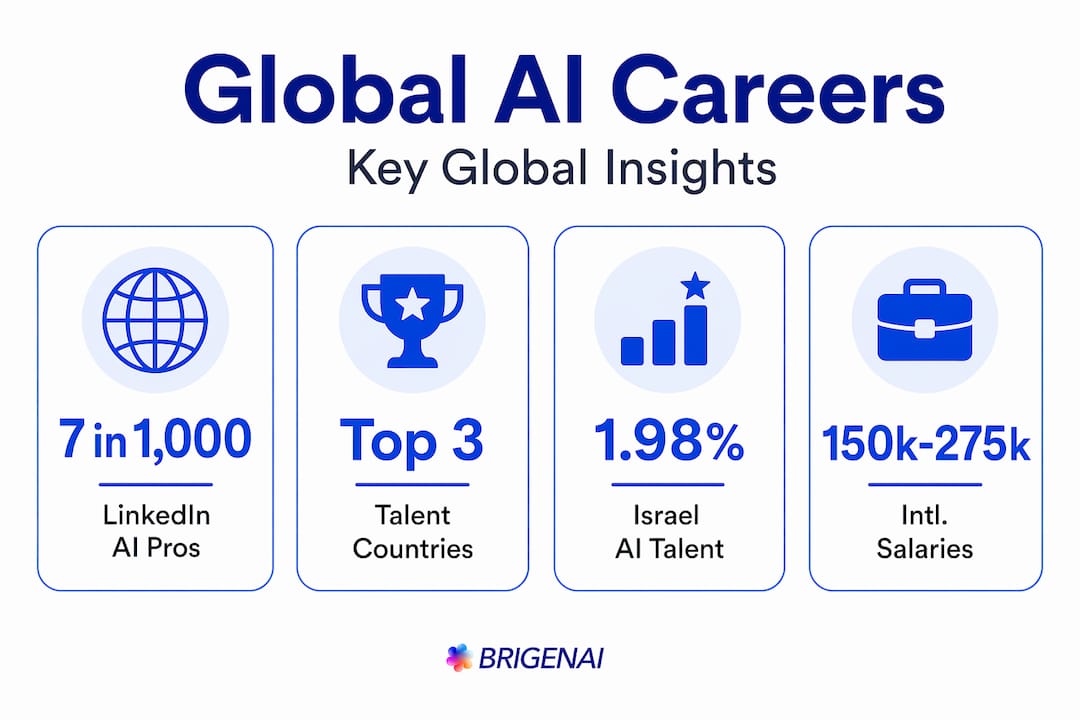
This matters for relocation planning. It means careers in artificial intelligence are genuinely distributed, and the country you move to may have a more active AI hiring market than you expect. Equally important: AI literacy skills grew by roughly 600% in recent years, meaning the pool of people you will be competing with, and collaborating with, is expanding fast.
| Country | AI talent concentration | Key sectors |
|---|---|---|
| Israel | 1.98% | Defence tech, cybersecurity, R&D |
| Singapore | 1.64% | Fintech, government AI, logistics |
| Luxembourg | 1.45% | Finance, data governance, EU compliance |
| United States | High volume | Cloud platforms, consumer AI, enterprise |
| Australia | Growing | Mining tech, health AI, public sector |
Understanding these concentrations helps you make smarter decisions when comparing international career pathways. A role in Singapore’s fintech sector operates under very different constraints and opportunities than the same title in a European regulatory environment.
One thing worth flagging: concentration of AI talent does not always equal concentration of AI jobs. Smaller markets like Luxembourg are dense with talent partly because the financial sector demands it, but total job volume remains limited. Larger markets like Australia and the UK offer more absolute AI job opportunities even if the per-capita density looks lower. Clarifying your AI career pathways before committing to a destination avoids this common miscalculation.
Salary expectations and role profiles in international ai careers
Senior AI roles at major technology companies have set a salary benchmark that shapes expectations worldwide. A Principal Applied Scientist at Microsoft earns a base salary between USD $119,800 and $234,700 annually, with the upper end clustered in San Francisco Bay Area and New York City. Total compensation including equity and bonuses pushes well beyond those figures.

What do those salaries actually demand? Looking at how leading companies describe these roles tells you more than any salary guide. The Databricks Principal Research Scientist role, for example, prioritises efficiency and large-scale AI system work over pure academic research. That distinction matters. These are production-focused positions, not research-for-research’s-sake appointments.
What high-paying international AI roles typically require:
- Demonstrated experience shipping AI systems into production environments
- Track record of measurable business or operational impact
- Ability to work across cross-functional teams including product, engineering, and policy
- Familiarity with large-scale model training, inference optimisation, or applied ML pipelines
- Communication skills to present findings to both technical and non-technical stakeholders
How to position yourself for these roles:
- Build a portfolio of shipped work, not just experiments or Kaggle rankings
- Quantify the impact of your AI work in business terms (latency improvements, cost reductions, revenue lift)
- Frame your experience around the challenges of the specific market you are targeting
- Research local salary norms separately from US benchmarks, as gaps can be significant
- Understand visa sponsorship constraints, as many senior roles in Singapore and Australia carry specific eligibility requirements
Outside the US, salary expectations shift considerably. Senior AI roles in Australia typically range from AUD $150,000 to $220,000 for principal-level positions, while Singapore offers SGD $120,000 to $200,000 for comparable roles. European markets vary more widely, with Germany and the Netherlands sitting at the higher end. Browse current AI and machine learning job listings to get a real-time sense of what different markets are offering right now.
Work culture and management practices shaping ai adoption abroad
Here is a finding that should directly influence where you choose to relocate. Management practices explain most of the AI adoption gap between the US and Europe. It is not technology access. It is not talent. It is whether managers actively encourage AI tool use, provide training, and create space for experimentation.
For someone building an international AI career, this is critical intelligence. You might take a technically impressive role at a European firm only to find that AI usage is quietly discouraged, your tools are restricted by compliance teams, and management has no framework for evaluating your contributions in AI terms. This is not hypothetical. It plays out regularly.
Questions to ask prospective international employers before accepting:
- What AI tools do engineers and scientists currently have access to?
- Is there a formal AI training programme or upskilling budget?
- How does the team handle AI governance and compliance when deploying models?
- Has the company shipped AI products to production in the last 12 months?
- How does management evaluate AI contributions as distinct from general engineering output?
“The country you move to may have less influence on your AI career trajectory than the specific company you join within that country.”
US firms, particularly in tech, tend to create environments where AI usage is expected and visible. Many European firms are catching up, but the gap is real and workplace-specific. Before committing to a relocation for an AI role, read the AI adoption and career guidance insights to understand how these cultural factors play out across different regions.
Pro Tip: Ask to speak with a current team member during your interview process, not just the hiring manager. Ask them directly how often they use AI tools in their daily work and whether the company has changed its stance on AI in the last year. Their answer tells you more than any job description will.
Skills and lifelong learning strategies for international ai professionals
One of the least comfortable truths about AI careers is this: AI-specific skills are a small share of overall employer demand. Foundational digital literacy, cognitive flexibility, and socio-emotional skills are what separate professionals who adapt well internationally from those who stall.
This is not an argument against technical depth. It is an argument for building around it. An international relocation adds cultural adjustment, communication challenges, and new institutional norms on top of an already demanding role. The professionals who thrive are those with strong analytical reasoning, adaptability, and the social intelligence to build credibility quickly in a new environment.
Skills to prioritise for sustainable international AI careers:
- Core ML and AI fundamentals — not just tool familiarity, but understanding of model behaviour, failure modes, and evaluation methods
- Statistical reasoning — the ability to interpret model outputs critically and communicate uncertainty
- Cross-cultural communication — essential for distributed teams and international stakeholder management
- Data governance literacy — understanding of privacy regulations (GDPR, Australia’s Privacy Act, Singapore’s PDPA) that govern AI deployment
- Systems thinking — the capacity to see how AI components interact with broader product and organisational systems
- Continuous learning habits — structured approaches to upskilling that do not depend on employer-provided programmes
The lifelong learning for AI careers approach matters more internationally because learning environments vary so much. Some countries and companies invest heavily in professional development. Others leave it entirely to the individual. Knowing how to direct your own growth is a non-negotiable skill for anyone pursuing AI job opportunities across borders.
Pro Tip: Build a personal learning system before you relocate, not after. Identify three to five high-quality resources you can rely on regardless of employer support, and commit to a weekly review habit. Consistency across disruption is what compounds over time.
Practical strategies for adapting to international ai career environments
Adaptation starts before you land. The professionals who transition smoothly into international AI roles spend time before the move understanding the specific priorities of their target market, not just polishing a generic CV.
Employers screen for shipped AI capabilities and production readiness. They are not particularly impressed by coursework, certifications in isolation, or a list of frameworks. What moves hiring decisions is evidence that you have taken an AI system from problem to production and dealt with real-world complexity along the way.
Portfolio alignment to local priorities is equally important. A portfolio built around consumer recommendation systems lands differently in Singapore’s fintech market than it does in San Francisco. Research what the target team values, whether that is efficiency, safety, regulatory compliance, or scale, and frame your work accordingly.
Core adaptation strategies for international AI professionals:
- Reframe past projects around business impact, not technical novelty
- Research the regulatory environment governing AI in your target country
- Connect with local AI communities before relocating (meetups, LinkedIn groups, industry events)
- Understand the visa and work authorisation requirements specific to AI roles in your target country
Evaluating a firm’s AI enablement during the hiring process is one of the most underrated adaptation strategies. It dramatically increases career satisfaction post-move.
| Adaptation challenge | Strategy | Expected outcome |
|---|---|---|
| Portfolio misalignment | Research local priorities and reframe projects | Higher interview conversion rates |
| Cultural work norms | Speak to current employees before accepting | Fewer post-move surprises |
| Regulatory unfamiliarity | Study local AI governance frameworks | Faster onboarding and credibility |
| Salary benchmarking | Use local market data, not US figures | Realistic negotiation anchors |
| Isolation post-relocation | Build community connections before moving | Faster professional integration |
Use interview strategies for AI careers to sharpen how you present production experience, and explore career adaptation strategies to build a structured plan for the transition itself.
Why focusing on employer ai enablement beats job title for career success
Most professionals pursuing AI careers internationally spend enormous energy on the wrong variable. They optimise for job title, company brand, and salary band. What they underinvest in is understanding whether the employer actually enables AI work in practice.
The evidence on this is clear. Management encouragement of AI tool use and access to appropriate training explains far more of the variation in AI adoption across companies than the sector or country alone. A Principal AI Engineer at a firm where management does not support AI experimentation will stagnate faster than a mid-level practitioner at a company that actively builds AI capability into daily workflows.
This matters most for international movers because you are already absorbing significant disruption. Cultural adjustment, rebuilding your professional network, and understanding new institutional norms all consume cognitive energy. The last thing you want is to also be fighting an internal culture that treats AI as a compliance risk rather than a capability.
Before any international AI role offer, treat the evaluating AI work culture process as seriously as you treat salary negotiation. Ask about AI tooling access, governance structures, and whether senior leadership has publicly committed to AI investment. A company that cannot answer those questions clearly is telling you something important.
The title on your business card will not accelerate your AI career. The environment that surrounds it will.
Start your international ai career journey with expert tools and resources
Knowing where AI talent concentrates, what employers expect, and how culture shapes your day-to-day experience is the foundation. Turning that knowledge into an actual international move requires a different kind of support.
BRIGENAI is built specifically for professionals making this transition. Whether you are preparing for relocation or comparing destinations, the international relocation checklist gives you a structured starting point that covers everything from visa requirements to cost of living benchmarks. The expat tools hub pulls together salary data, workplace culture insights, and community experiences so you are not navigating blind. And when you are ready to search for roles, the AI and machine learning jobs portal surfaces opportunities curated for professionals with your background and target destinations in mind. Your next move deserves more than a generic job board.
Frequently asked questions
What are the top countries for AI career opportunities internationally?
Israel, Singapore, and Luxembourg currently hold the highest AI talent concentrations globally, making them strong destinations alongside established markets like the US, Australia, and the UK.
How much can I expect to earn working in AI internationally?
Senior AI roles in the US range from USD $119,800 to $274,800 annually depending on location and level, with other regions like Australia and Singapore offering strong but typically lower salaries in local currency.
What skills are most valued for AI jobs overseas?
Employers value a combination of technical AI skills and foundational abilities; AI-specific skills remain a small share of total demand, with digital literacy, critical thinking, and socio-emotional skills carrying significant weight in hiring decisions.
How does work culture affect AI adoption in different countries?
Management practices drive most of the AI adoption gap between regions, with active encouragement, tool access, and training support mattering far more than technology availability alone.
What should I consider when relocating internationally for an AI career?
Assess the employer’s AI enablement culture thoroughly, align your portfolio to local market priorities, and build a self-directed learning system before you move, as continuous upskilling is essential when AI reshapes roles across every region.