
TL;DR:
- AI can handle up to 90% of routine career coaching tasks, providing fast and personalized advice. Human advisors excel in empathy, cultural nuance, and complex decision-making, especially during high-stakes transitions. Combining AI and human support creates the most effective hybrid approach for Asia-Pacific professionals pursuing international careers.
Many Asia-Pacific professionals still assume that navigating an international career move demands a human advisor at every turn. That assumption is being quietly dismantled. AI can handle up to 90% of day-to-day career coaching functions, with 96% of users reporting personalised advice, 90% finding it straightforward to use, and 89% getting actionable next steps. For professionals in Australia, Singapore, Taiwan, and beyond who are weighing up a global career transition, the question is no longer “AI or human?” It is “how do I use both wisely?” This guide breaks that down.
Table of Contents
- What can AI and human advisors do: Comparing core strengths
- Where AI shines: Routine guidance, skill mapping, and data-driven insights
- Where human advisors excel: Emotion, context, and complex transitions
- The hybrid approach: How to combine AI and humans for career success
- Why picking sides is old thinking: A smarter way to get guidance
- How BRIGENAI accelerates your global career journey
- Frequently asked questions
Key Takeaways
| Point | Details |
|---|---|
| AI speeds routine guidance | AI delivers fast, personalised support for skills mapping, job search, and labour market research. |
| Humans excel in complex cases | Human advisors offer empathy and cultural insight, critical for emotional support and career pivots. |
| Hybrid approaches outperform | Mixing AI and humans maximises outcomes, trust, and confidence during job transitions in APAC. |
| Choose based on your needs | Pick the right balance of AI and human input for your specific career challenges and relocation goals. |
What can AI and human advisors do: Comparing core strengths
Now that you know AI is more capable than you might think, let’s break down what each type of advisor really brings to the table.
The distinction is not about one being better than the other. It is about fitness for purpose. AI excels in speed, scalability, and personalisation, while human advisors deliver empathy, intuition, and cultural nuance that no algorithm has fully replicated. Understanding where each approach performs best is the first step to using your guidance budget wisely, whether that budget is measured in time, money, or energy.
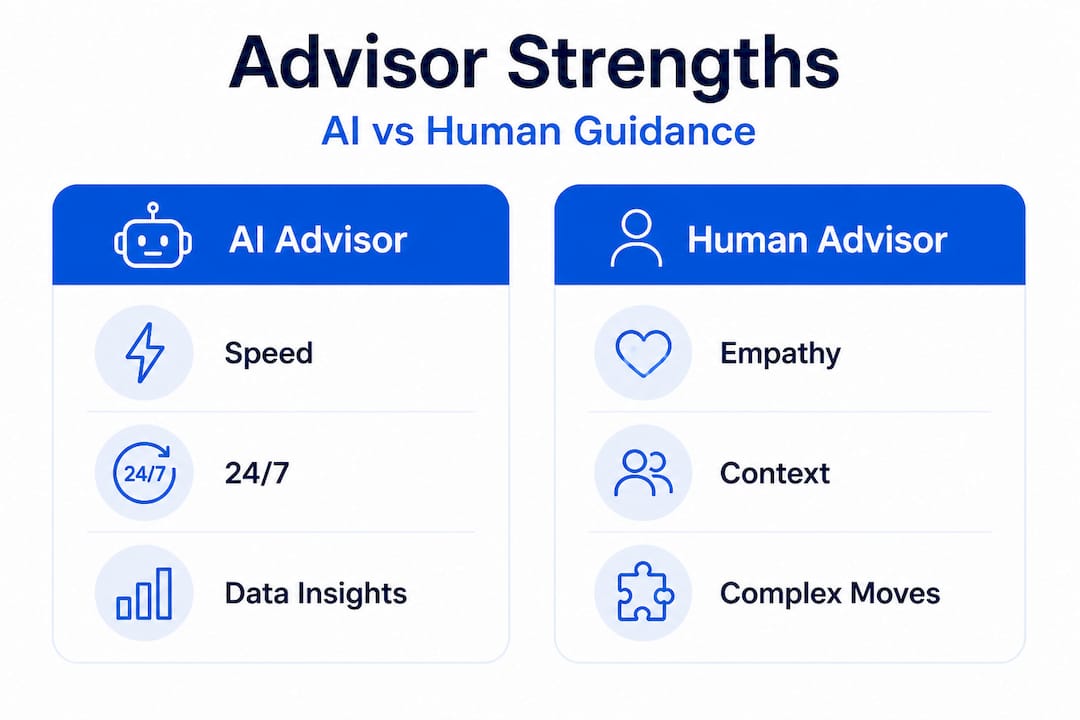
| Feature | AI advisor | Human advisor |
|---|---|---|
| Availability | 24/7, instant responses | Business hours, appointment-based |
| Cost | Low to free | Medium to high |
| Scalability | Handles thousands simultaneously | One client at a time |
| Emotional support | Limited | Strong |
| Cultural nuance | Moderate | High |
| Complex case handling | Adequate for routine | Essential for complex transitions |
| Speed | Near-instant | Days to weeks |
| Personalisation | Data-driven | Experience-driven |
For routine tasks like CV formatting, salary benchmarking, or shortlisting roles in a new country, AI performs reliably and fast. But consider a Filipino engineer relocating to Melbourne who is wrestling with whether to accept a lower-ranking role to gain Australian experience, while managing family pressure back home. That conversation needs a human. The emotional weight, the cultural context, and the long-term implications require someone who has walked a similar path.
There are also scenarios where AI vs human coaches offer a genuinely different kind of value at the same stage of a journey. A human career advisor in Singapore might tell you which industries are hiring right now based on their network. An AI platform can instantly cross-reference that against your skill profile and surface five relevant roles with visa sponsorship pathways. Both are useful. Together, they are powerful.
“The most effective career guidance for international moves comes not from choosing one type of advisor over another, but from matching the right support to the right stage of the journey.”
Key strengths at a glance:
- AI advisors: Fast feedback, consistent availability, data-driven job matching, scalable skill assessments, cost-effective for ongoing queries
- Human advisors: Emotional intelligence, lived relocation experience, complex case navigation, cultural translation, relationship-based trust
Where AI shines: Routine guidance, skill mapping, and data-driven insights
With the big-picture strengths in mind, let’s look at situations where AI truly makes a difference.
For Asia-Pacific professionals at the start of an international career journey, information overload is a real barrier. Which visa pathway applies to your occupation? Is your salary expectation realistic in Auckland versus Kuala Lumpur? Do you have the skills employers in Singapore actually want? AI platforms answer these questions quickly, consistently, and without judgement.

Research from Singapore shows that AI-assisted platforms improved skill gap awareness and career readiness among students preparing for the workforce. This is not limited to graduates. Mid-career professionals using AI career tools report sharper clarity around where their experience sits in a new market and what they need to bridge the gap.
The data from Indonesia is equally striking. AI guidance reduced career anxiety by 26.7% among vocational students, a finding that points to something important: knowing where you stand reduces fear. When an AI platform maps your skills, identifies transferable competencies, and flags the roles most likely to sponsor your visa, you move from overwhelmed to informed.
Specific tasks where AI advisors excel for APAC job seekers:
- CV and cover letter review: Instant feedback on formatting, keywords, and alignment with target roles
- Skill gap analysis: Comparing your profile against employer requirements in your destination country
- Job matching: Filtering thousands of listings by visa sponsorship availability, salary range, and role fit
- Salary benchmarking: Providing data-driven comparisons across cities, industries, and experience levels
- Market research: Flagging hiring trends, in-demand occupations, and employer reputations in real time
- Interview prep: Practising responses and receiving structured feedback at any hour
| APAC job seeker benefit | What AI delivers |
|---|---|
| Cost | Free or low-cost tools accessible across all income levels |
| Speed | Instant responses versus days for human callbacks |
| Access | Available at 2am when anxiety peaks and planning happens |
| Consistency | Same quality of information regardless of time or platform mood |
| Breadth | Covers multiple countries and industries simultaneously |
Pro Tip: Before you book a paid consultation with a human career advisor, use an AI career mapping tool to clarify your skill profile, target roles, and top questions. You will get far more value from the human session because you arrive prepared rather than starting from scratch.
The rise of online mentoring platforms has also made AI-assisted career guidance more accessible across the region. Platforms designed specifically for skilled migrants and international job seekers now combine automated skill profiling with curated human mentors, giving you the efficiency of AI alongside the nuance of lived experience. Understanding how AI career navigation tools work in practice can help you decide where to invest your time and attention first.
Where human advisors excel: Emotion, context, and complex transitions
While AI is brilliant for many tasks, there are moments it simply cannot replace human expertise and understanding.
Picture a Malaysian marketing manager who has just received a conditional job offer from a Sydney firm. The salary is lower than expected, the visa process is unclear, and her ageing parents are expressing concern about the move. She is excited but also frightened. She needs someone who has navigated exactly this kind of moment, not a chatbot that can only surface statistics about the Sydney job market.
Human coaches excel in emotional support and handling complex issues like relocation, career pivots under pressure, and decisions with significant personal consequences. This is where lived experience and genuine empathy create guidance that actually lands.
Situations where human advisors are essential:
- High-stakes negotiations: Salary discussions with prospective employers, especially across cultural contexts where direct negotiation styles differ widely
- Visa complexity: Cases involving previous refusals, complex employment histories, or occupations on the borderline of eligibility
- Career pivots mid-life: Moving from one industry to another in a new country requires both strategic advice and emotional steadiness
- Family and lifestyle considerations: Balancing a partner’s career, children’s schooling, and community needs alongside your own ambitions
- Cultural integration: Understanding unspoken workplace norms in a new country goes well beyond anything a data-driven tool can teach
“The human element is not a backup plan. For anyone facing a major life transition tied to their career, it is often the difference between a plan that looks good on paper and one that actually succeeds.”
Nearly 80% of affluent households prefer human advisors for trust and behavioural coaching when major decisions are involved. The same dynamic applies to career moves. When the decision carries real financial and personal risk, people want a human being who can look them in the eye, understand their full situation, and offer advice grounded in judgement rather than just data.
Pro Tip: When assessing human advisors, look specifically for someone who has made the same type of move you are planning. A career counsellor who relocated from the Philippines to Melbourne will understand things about that specific journey that no generalist can match. Use overseas career transitions resources to find advisors with that kind of relevant experience.
The irreplaceable quality of a skilled human advisor is context sensitivity. They do not just answer the question you asked. They hear what you did not say, pick up on the hesitation in your voice, and ask the question that actually unlocks the path forward.
The hybrid approach: How to combine AI and humans for career success
Given each approach’s strengths, what is the best way to get the guidance you need?
Hybrid models are strongly recommended by career researchers: use AI for routine tasks and reserve human advisors for edge cases involving relocation complexity, career pivots, or emotional distress. This is not just practical advice. It is backed by results. Hybrid models achieve better performance, trust outcomes, and result retention compared to either approach used alone.
How to build your hybrid guidance stack:
- Start with AI to complete your skills audit, research destination countries, and shortlist target roles using AI job matching tools
- Use AI to draft your CV, benchmark your salary expectations, and prepare preliminary interview answers
- Book a human advisor session once you have clarity on your direction, to validate your plan and get cultural or strategic input
- Return to AI tools between human sessions to act on feedback, research further, and track progress
- Reserve your human advisor time for moments of genuine complexity or emotional difficulty
| Situation | Best advisor type |
|---|---|
| Initial skills audit | AI |
| CV drafting and review | AI |
| Salary benchmarking | AI |
| Complex visa pathway | Human |
| Salary negotiation strategy | Human |
| Family and lifestyle trade-offs | Human |
| Weekly job search support | AI |
| Career pivot with high stakes | Human |
| Market trend research | AI |
| Cultural integration guidance | Human |
In the APAC context specifically, cultural and regulatory factors make human oversight critical even when AI handles the bulk of the process. Visa rules change, industry norms vary dramatically between countries, and the lived reality of relocating to Taiwan differs enormously from moving to Auckland. No AI platform captures that granularity as reliably as someone who has done it. This is why book a demo sessions with hybrid platform advisors are increasingly popular among professionals who want structured AI tools alongside real human accountability.
The most effective career movers in APAC are not the ones who rely entirely on technology, nor the ones who distrust it. They are the ones who know which tool to reach for, and when.
Why picking sides is old thinking: A smarter way to get guidance
Most articles on this topic frame AI and human advisors as competitors. That framing is not just outdated. It actively misleads professionals who are trying to make genuinely important decisions about their careers and lives.
The binary choice question, “should I use AI or a human advisor?”, assumes your career transition is a standard problem with a standard solution. It is not. International career moves across the Asia-Pacific region involve a web of variables: immigration law, labour market dynamics, cultural fit, family logistics, personal confidence, and financial risk. No single tool or person addresses all of that equally well.
What we have seen through the experiences of professionals who have successfully relocated is that the ones who get the best outcomes are those who treat their guidance mix as something to actively manage rather than passively receive. They start with AI to get oriented quickly and cheaply. They bring in human expertise at the moments where judgement, empathy, and lived experience matter most. And they adjust that mix as their situation evolves.
The idea that using AI makes your guidance less personal, or that relying on a human advisor is somehow more thorough, is a false trade-off. Understanding how AI career copilot tools work alongside human support reveals something important: the two are most powerful when they complement each other rather than compete.
Your career is not standardised. Your guidance should not be either. The professionals who thrive internationally are not the ones who find the “right” advisor type. They are the ones who build a flexible, responsive support system and keep refining it as they go.
How BRIGENAI accelerates your global career journey
Ready to take the next step? Here is how BRIGENAI bridges the gap for professionals like you.
BRIGENAI is built for exactly this kind of hybrid approach. The platform combines structured AI tools with vetted human advisors who have actually made the international career moves you are planning.
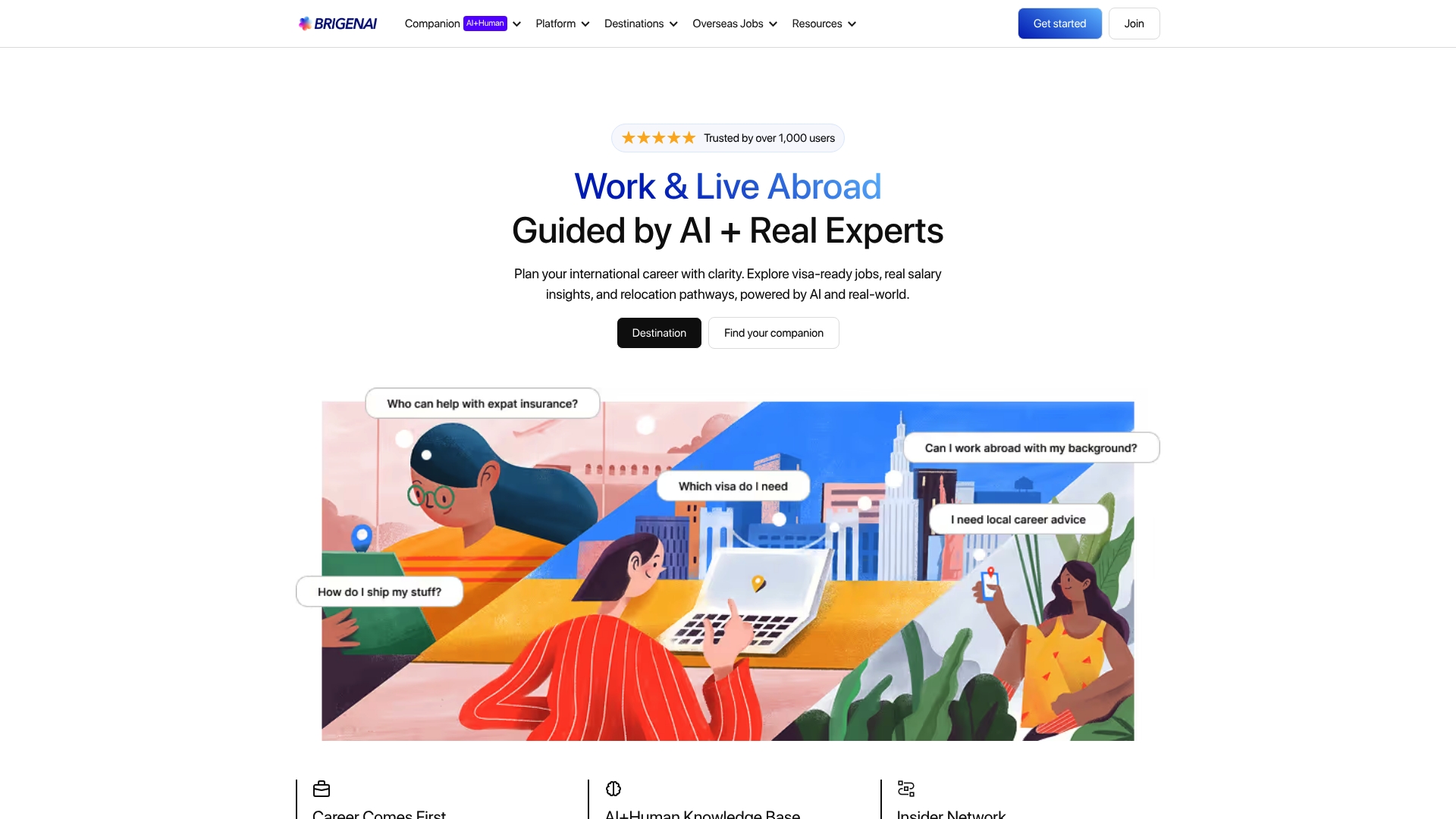
Explore skilled migration careers and occupation lists to confirm your eligibility, then use relocation services support to plan your move with confidence. Real-time global salary benchmarks give you data-backed leverage in every negotiation. Whether you need AI-powered copilot tools to get oriented fast or one-on-one sessions with advisors who have lived the same journey, BRIGENAI brings both together in one place. Over 1,000 professionals have already used it to move smarter.
Frequently asked questions
Can AI fully replace human career advisors for international job seekers?
AI covers most routine guidance effectively, but human advisors remain vital for complex, emotional, and high-risk career moves. AI can handle up to 90% of day-to-day coaching functions, but the remaining 10% often includes the decisions that matter most.
Are hybrid AI-human models more effective than using just one advisor type?
Evidence consistently supports hybrid approaches over pure AI or human-only models for trust, guidance quality, and outcomes. Hybrid models achieve better performance and retention compared to either approach used in isolation.
What are the most common tasks AI advisors handle for Asia-Pacific job seekers?
AI platforms typically manage CV reviews, job matching, skills assessment, and market research. AI-assisted career platforms improve skill gap awareness and career readiness, making them an ideal first step for professionals preparing for an international move.
Why do some people still prefer human advisors over AI?
Trust, empathy, cultural understanding, and support during emotionally complex changes drive the preference for human advisors. 69% of Australians prefer human advice, and 80% of affluent households value behavioural coaching when major decisions are at stake.
Is AI guidance culturally effective for professionals relocating in the Asia-Pacific region?
AI supports efficient skill mapping and awareness-building, but cultural nuances and complex situations still require human oversight. APAC adoption is high, but regulatory complexity and cultural variation mean humans play a critical role in validating and contextualising AI-generated guidance.